
Quick Answer
The best MCA colleges in Delhi NCR combine UGC/AICTE-recognized affiliation, updated software labs, and strong placement tie-ups with IT companies. Top picks include Jamia Millia Islamia, Guru Gobind Singh Indraprastha University (GGSIPU) colleges, Delhi Technological University (DTU), Amity University, and career-focused institutes like DITR India, which offers an industry-oriented MCA program with practical training and placement support. Choose a college based on affiliation, faculty experience, lab infrastructure, fee structure, and placement record — not brand name alone.
If you’re searching for MCA colleges in Delhi, this guide breaks down exactly what to check before you enroll, so you don’t waste a year (or a lakh of rupees) on the wrong choice.
Why MCA is Still a Smart Career Choice in 2026
The Master of Computer Applications (MCA) remains one of India’s most in-demand postgraduate degrees, especially with software development, cloud computing, and AI-driven roles growing across Delhi NCR’s booming IT and startup ecosystem. According to NASSCOM industry data, India’s IT sector continues to add lakhs of new tech jobs every year, and Delhi NCR — home to Gurugram’s corporate hubs and Noida’s IT parks — is one of the biggest hiring zones in the country.
An MCA degree typically opens doors to roles such as:
- Software Developer / Full-Stack Developer
- System Analyst
- Database Administrator
- Cloud & DevOps Engineer
- IT Project Manager
The real value, though, comes from where you study — not just the degree itself.
What Makes an MCA College “Best”? (The Real Checklist)
Before comparing names, understand the factors that actually affect your career outcome:
1. Recognition and Affiliation
Confirm the college is approved by AICTE and affiliated with a UGC-recognized university. You can verify a college’s approval status directly on the AICTE portal — this affects the validity of your degree for government exams and PSU recruitment.
2. Curriculum Relevance
Look for updated syllabi covering Python, Java, cloud computing, AI/ML basics, and data structures — not outdated theory-only courses.
3. Lab Infrastructure
Practical coding exposure matters more than lecture hours. Ask about lab-to-student ratios and whether labs run on current software versions.
4. Placement Support
Check the last three years’ placement data: average package, highest package, and the number of companies that actually visited campus (not just “tie-ups” listed on a website).
5. Faculty Experience
Faculty with industry background (not just academic degrees) bring real-world project exposure into the classroom.
6. Fees vs. ROI
A ₹6-lakh MCA with weak placements is a worse investment than a ₹2-lakh MCA with strong industry connections.
Top MCA Colleges in Delhi NCR (2026)
| College | Affiliation | Approx. Annual Fees | Known For |
| Jamia Millia Islamia | Central University (UGC) | ₹15,000–₹25,000 | Strong academics, low fees |
| GGSIPU-affiliated colleges | GGSIPU, Delhi | ₹80,000–₹1,50,000 | Wide network of colleges, entrance-based admission |
| Delhi Technological University (DTU) | State University | ₹1,00,000+ | High placement packages, top recruiters |
| Amity University, Noida | Private, UGC-approved | ₹1,50,000–₹2,50,000 | Corporate exposure, modern campus |
| DITR India | AICTE/UGC-recognized affiliation | Budget-friendly | Practical, industry-oriented MCA training with placement support |
Note: Fees vary by academic year and category (general/reserved). Always confirm current figures directly with the admission office.
DITR India’s MCA Program
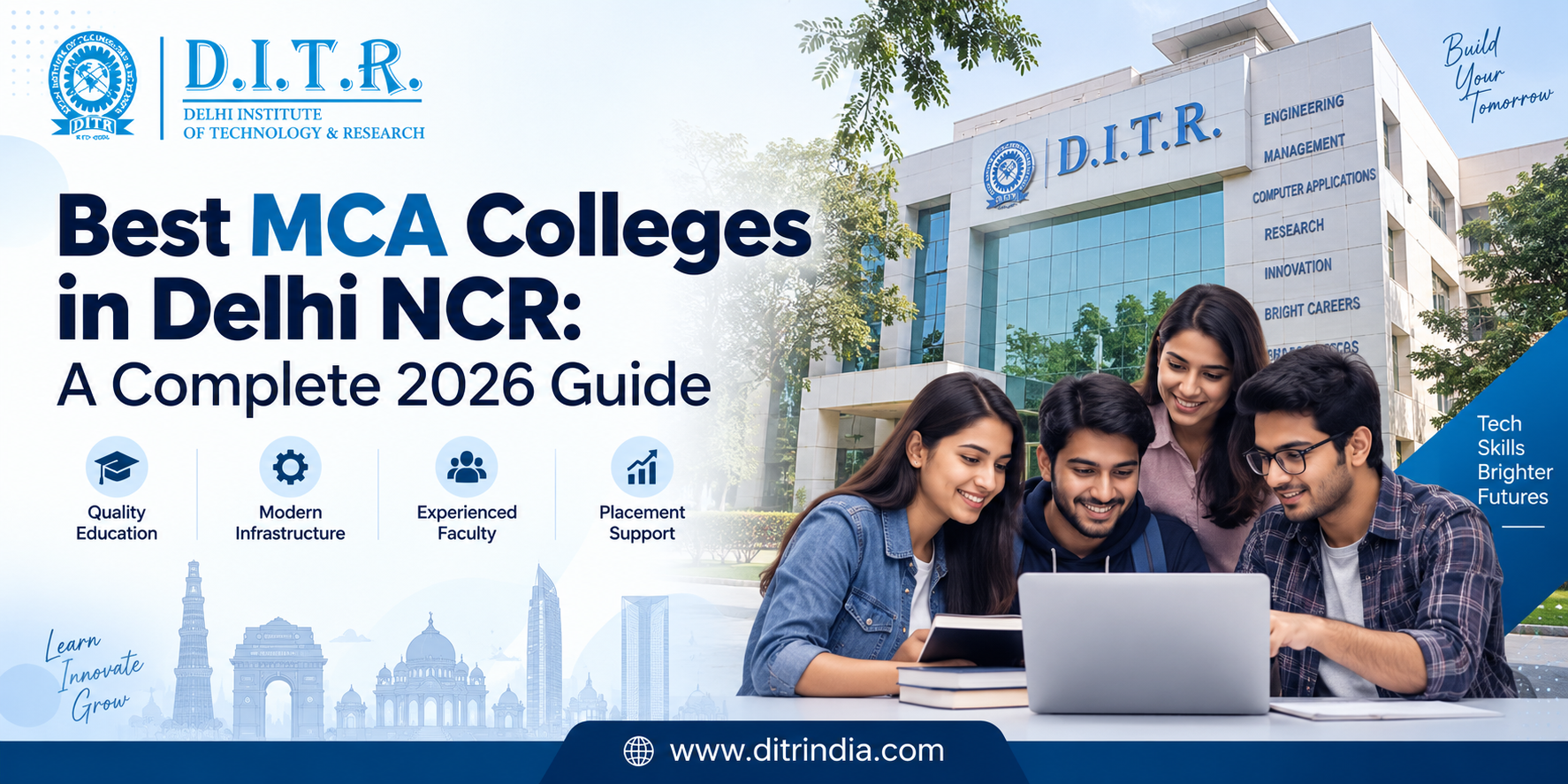
DITR (Delhi Institute of Technology & Research) runs a career-focused MCA program built around hands-on coding practice rather than pure theory. The institute pairs classroom learning with functional computer labs, experienced faculty, and structured placement guidance — a practical option for students who want job-readiness without the high fees charged by large private universities. Students also get access to e-learning resources and skill-development workshops alongside the core MCA curriculum. You can review the MCA course details on DITR’s website for eligibility and admission steps.
MCA Eligibility Criteria (Delhi NCR, General Norms)
- Bachelor’s degree with Mathematics at 10+2 or graduation level (BCA, B.Sc. CS, or equivalent)
- Minimum 50–55% aggregate marks (varies by college/category)
- Entrance exam scores where applicable — for example, GGSIPU’s CET (IPU CET) or other university-specific tests
- Some private/institute-run programs admit on merit of qualifying degree marks, without a separate entrance exam
Always check the specific university’s admission bulletin each year, since eligibility percentages and exam requirements can shift.
Government vs. Private MCA Colleges: Which Should You Choose?
Choose government/university-affiliated colleges (Jamia, DTU, GGSIPU) if:
- You can clear entrance exams
- Lower fees matter more than campus infrastructure
- You want a widely recognized university name on your degree
Choose private/institute-based programs (like DITR) if:
- You want practical, hands-on training with smaller batch sizes
- You prefer direct admission without a competitive entrance exam
- You need flexible support such as career guidance and placement assistance built into the program
- Budget and location convenience matter for a working or first-generation learner
There’s no universal “best” — only the best fit for your marks, budget, and career goals.
Expert Tip: Don’t Just Check Rankings — Check Outcomes
A common mistake students make is picking a college purely on a “Top 10” list found online. Instead, ask current students or alumni these three questions:
- What was the actual placement rate last year (not just the highest package)?
- Are the labs updated with current software tools?
- Does the faculty have real industry project experience?
These answers tell you far more than a generic ranking article ever will.
FAQs
- Which is the best MCA college in Delhi for a low budget?
Government-affiliated colleges under Jamia Millia Islamia or GGSIPU offer MCA at relatively low fees, while institutes like DITR India provide budget-friendly, practical training with placement support as an alternative to expensive private universities.
- Is MCA still valuable in 2026 given the rise of BCA and B.Tech?
Yes. MCA remains valuable for graduates without a computer science background who want to enter IT roles, since it provides an intensive, focused path into programming, systems, and software development.
- What is the average fee for MCA in Delhi NCR?
Fees range widely — from around ₹15,000–₹25,000 per year at government universities to ₹1,50,000–₹2,50,000 per year at private universities. Institute-based programs often fall on the more affordable end.
- Do I need an entrance exam for MCA admission in Delhi?
Many university-affiliated colleges require entrance exams like GGSIPU CET, while several private institutes admit students based on graduation marks, so requirements vary by college.
- What jobs can I get after completing MCA?
Common roles include software developer, system analyst, database administrator, cloud engineer, and IT project manager, with opportunities across Delhi NCR’s strong IT and startup sector.
Conclusion
Picking the right MCA college in Delhi NCR comes down to matching your budget, eligibility, and career goals with a program that offers genuine practical training and placement support — not just a recognizable name. Whether you aim for a government university or a focused, industry-oriented institute, verify affiliation, lab quality, and real placement outcomes before you enroll.
If you’re looking for a practical, affordable MCA program with hands-on training and placement guidance, explore the MCA course at DITR India or get in touch with our admissions team to know more about eligibility, fees, and the next batch start date.
Call: +91 9883838324
Email: ditrdelhi@gmail.com

